Ralph Hedley’s hunting pictures on the North York Moors

I was in Helmsley recently and missed the chance to visit the site of two unusual paintings by Ralph Hedley.

Spout House/the old Sun Inn is on the B1257 as it runs from Helmsley to Stokesley, across the North York Moors National Park. There are not many houses up there, but Spout House has been there for hundreds of years. Built in the 1500s as a farm house, it became the Sun Inn in 1714, and closed in 1914 when it was replaced by the new Sun Inn built close by.

The interior of Spout House/ the old Sun Inn, is featured in Hedley’s Hunting morn (1895), and the exterior is in his Counting the game (1902). Both pictures show rural huntsmen, and both were arranged, possibly commissioned, by Allan Bowes Wilson of Hutton Rudby.

A letter of 12 September 1893, from Allan Bowes Wilson, arranged for Ralph Hedley to go to the old Sun Inn to paint members of the Bilsdale hunt. Wilson said Hedley would be staying 4 miles away at ‘Chop Yat Hostel’, and invited him to bring his bicycle.

‘Chop Yat’ (now called Chop Gate) means ‘pedlars’ way’. The word ‘chop’ is said to derive from an Old Norse word ‘ceap’ or ‘kaup’ for pedlar or chapman. ‘Yat’ is a local dialect word for gate or route.

Years after he arranged for Hedley to paint Hunting morn, Allan Bowes Wilson commissioned Counting the game for £50. It shows the results of a day’s shooting laid on the ground outside the old Sun Inn. The window that features in Hunting morn is seen from the outside in Counting the game, and is surrounded by sun-flowers.

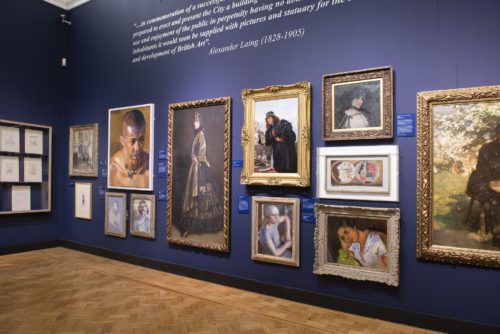
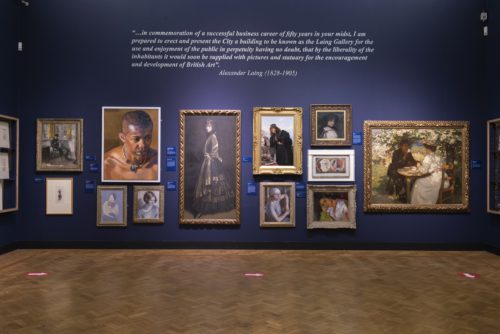
Allan Bowes Wilson ran a sailcloth factory in Hutton Rudby, founded by his father George Wilson. Bales of his sailcloth appear in the bottom right hand corner of Ralph Hedley’s painting The sail loft (1908) which is on show in the Northern Spirit display at the Laing Art Gallery, Newcastle. One of the bales in the picture is inscribed –

42

1

GEo WILSON

HUTTON RUDBY

CLEVELAND

YORKSHIRE

_____

 TORNADO

'Hunting morn' as an advert for Bovril.

In his letter Allan Bowes Wilson identified the men of the Bilsdale Hunt depicted in Hedley’s painting Hunting morn -

  • Whipper-in ,Bobby Dowson
  • Hunt master, Robert Kitching
  • Huntsman, Nicholas Spink
  • Nicholas Spinks’s brother, Richard, was the ‘plain-clothes man’, not wearing the ‘hunting pink’.

The woman with the tray was Phoebe Barr, of the family who ran the Sun Inn, and the girl at the window is her niece, Ruth Ainsley.

'Hunting morn' as an advert for whiskey.

Colour prints of Hunting morn were used, apparently without Hedley’s permission, to advertise Bovril and Norman Brown whiskey. An extra man appears in the advertising prints and the girl in the window disappears in one of them.

There are also more subtle differences. The round table in the painting has turned legs, whereas they are plain in the prints. The rectangular table disappears altogether in the Bovril print.

Two people who didn’t miss a chance to visit Spout House/old Sun Inn, took some great photos in 2005. You can find them at -

http://homepage.ntlworld.com/paulrose.r/Walking%20Diary/NYM%20Walks/Bilsdale%20Views/bilsdale_views.htm

Fifties Fashion…

After years of austerity during World War II, the following era could be characterised by the revival of Haute Couture.  The structured square shoulders and shorter skirts of the war years were replaced with the softer feminine silhouette, rounded shoulders and fitted waists of the ‘New Look’. This ‘New Look’ was synonymous with Christian Dior whose first collection; the Corolle line, in the Spring-Summer of 1947, would set the trend for the next decade and forever be remembered in fashion history.

Christian Dior, 1956

Although the style of the ‘New Look’ was a significant chapter in fashion history, the look was actually not that new. The style was an exaggerated take on the fashion trends of the late 1930’s and the occupation styles. Clothing was no longer as square or structured in appearance as the styles of the 1940’s; however, the softness of the ‘New Look’ silhouette was deceiving.  The curved shoulders and full skirt of Dior’s clothes relied on an inner construction of new interlining materials to shape the silhouette. A result of the Post-World War II economic expansion was a flood of synthetic fabrics and easy-care processes. Drip-dry nylon, orlon and dacron, which could retain heat-set pleats after washing, became immensely popular in the period.

Heiress, 1955-1959

 For some of the war weary population, the ‘New Look’ symbolised hope for a new and more prosperous future, however others saw it as a reckless waste, when fabric was still in such short supply. The long billowing skirts; in some cases reaching to the ankle, required as much as fifteen yards of fabric!

Wendy, 1950-1958

Not only did this extensive use of fabric worry much of society, but some women  feared the obvious femininity of this new style, heralded a return of women to  the home and a less active role in society after years of wearing more functional clothing appropriate for work. Despite this very mixed response to the ‘New Look’, it would dominate the design of women’s clothing until the mid-late 50’s.

Jenny Hockley, 1959-1960

 For many women, the 1950’s brought with it a desire to appear elegant, mature and sophisticated. High fashion was still very formal and required clothes and accessories such as gloves and pearls for every occasion.

Tailored suits and twinsets with fitted peplum jackets, usually worn with long, narrow pencil skirts were very trendy for day wear. Day dresses with fitted bodices, full skirts, and low-cut necklines or peter pan collars, were also very popular, as were halter-top sundresses.  Evening gowns were often the same length as day dresses which was referred to as the ballerina length. Cocktail dresses for evening parties’ were often paired with short shrugs and bolero jackets in matching fabric.

1956

The styles and shapes of this era have a classic and timeless feel to them which evokes femininity and sophistication. The cinched waists, rounded shoulders and full skirts of this significant look have been recycled in many ways throughout contemporary fashion and it is likely they will continually reappear in the future.

Ralph Hedley and Lord Dundreary

Here’s another thing you won’t see in the Ralph Hedley exhibition at the Shipley Art Gallery until 2 November 2013.

I saw this carving by Ralph Hedley nearly 25 years ago, and took two photos of it at the owner’s house. The photos are not fantastic but you can make out a man in Victorian dress holding a handkerchief in his right hand and gesturing with his left hand as if he is explaining something. We called the carving ‘man with a monocle’ because he has a monocle in his left eye (though it’s hard to see in the photo).

I recently read an 1899 ‘Ten Minute Interview’ with Ralph Hedley. He said that, when he was an apprentice woodcarver in Newcastle, he used to do sketches at the theatre and ‘he carved statuettes of Southern as Lord Dundreary and as David Garrick’.

 It wasn’t hard to find a picture of the actor Edward Askew Sothern playing Lord Dundreary. He appeared in Our American cousin, a farce by English playwright Tom Taylor which premiered in New York in 1858.

The ‘man with a monocle’ was plainly Sothern as Lord Dundreary.


Sothern’s Lord Dundreary became famous in the U.S.A. and then in England, for his ad-libs and comic antics as a brainless English nobleman. His huge side-whiskers became known as ‘Dundrearys’, and people copied hisDundrearyisms’… messed-up sayings like ‘birds of a feather gather no moss’ or ‘many hands make two in the bush’.

Sothern was also a great success in the title role in Tom Robertson’s play David Garrick at the Haymarket Theatre, London, but it was Dundreary that was the ‘Greatest Dramatic Creation of the Age’ and which made Sothern a ‘Celebrated and World-renowned Comedian’.

For years Sothern toured in Our American Cousin, adding an extra scene and a song. He also worked up new productions for his most famous character – Lord Dundreary-Married and done for, Lord Dundreary’s Travels, and Dundreary’s Private Theatricals.

Sothern’s Lord Dundreary made five trips to Newcastle between 1862 and 1871. All appearances were at the Theatre Royal, except those of 1867 when they were at the Tyne Theatre – on Friday 18 and Saturday 19 October. Both of these performances featured Lord Dundreary and David Garrick, and it was probably one of them that the 18 year old Ralph Hedley attended, producing sketches for his carvings.

So the undated ‘man with  monocle’ is now Lord Dundreary (1867?)… or at least he would be if I knew where he is now.

Incidentally, Our American cousin was the play that President Abraham Lincoln was watching when he was assassinated. The performance as at the Ford Theatre, Washington, and Lord Dundreary was played by the Washington actor E.A. Emerson.


New Books at the Great North Museum:Hancock Library

One of the pleasures of working as the Librarian in the Great North Museum:Hancock Library is that you get to look at all of the wonderful new books that are added to stock.

Ann Spencer, one of the new Library Volunteers, took the opportunity to write a review of David Attenborough’s book, First Life; A journey back in time, that was recently added to stock. Here are her thoughts….


This book is based on insights captured during the making of the accompanying TV series, with an introduction by David Attenborough. The book is a chronological account of the story of early life from Pre-Cambrain times to key events during the explosion of life in the Cambrian period. The story of how geologists pieced together the puzzle of how living creatures survived the Ice Age has more in common with a Sherlock Holmes adventure than the work associated with activities in a laboratory.


Although the book deals with potentially difficult subject matter the text is well written and accessible to readers who have little specialist scientific knowledge. There are some magnificent photographs including computer generated images of plants and animals extrapolated from their fossils.


One of the many delights of this book is the insight it provides into the young David Attenborough’s enthusiasm for fossil hunting, a passion which prompted his interest in the natural world which has given pleasure to so many of us.

Listed below is a selection of some of the other new purchases and donations that have been recently added to the Library. To view the full records please go to NewcastleUniversity’s Library Catalogue.

Breeze, David J (Editor),  200 Years – The Society of Antiquaries Newcastle Upon Tyne 1813 – 2013,   SANT,  2013

Breeze, David J (Editor) The first souvenirs – enamelled vessels from Hadrian’s Wall,Cumberlandand Westmorland Archaeological Society 2012

Clark, Andrew & Nairn, Goerge,  Durham Coal – A people’s history,  People’s History, 2001

Curcic, Slobadon, Architecture as Icon – Perception and representation of architecture in Byzantine art,PrincetonUniversity, 2010

Dennis, Nigel & MacDonald, David Meerkats  A & C Black, 2009

Eilperin, Juliet,  Demon fish  – travels through the hidden world of Sharks, Duckworth, 2012

Gerstel, Sharon & Nelson, Robert,  Approaching theHolyMountain, Brepols,  2010

Grigs, Lucy & Kelly, Gavin (Editors), Two Romes –RomeandConstantinoplein late antiquity, OUP, 2012

Hodder, Ian, The present past – An introduction to anthropology for archaeologists, Batsford, 2012

Liverani, Paolo & Spinola, Giandomenico, The Vatican Necropoles  -Rome’s City of the dead, Brepols, 2010

Moyal, Ann,  Platypus – The extraordinary story of how a curious creature baffled the world, Smithsonian Institute, 2001

Orton, Fred,  Fragments of history – rethinking the Ruthwell andBewcastleMonuments, Manchster University Press,  2007

Pietsch, Oceanic anglerfishes  – extraordinary diversity in the deep sea, University of California, 2009

Prahms, Wendy, Animals inNewcastle  – An illustrated history, Tempus, 2008

Sands, Tim, Wildlife in trust – a hundred years of nature conservation, Wildlife Trusts, 2012

Scott, Bob, The illustrated birdwatcher’s handbook, Bounty, 2012

Smith, Charles H ,  Natural selection and beyond – the intellectual legacy of Alfred Russel Wallace, OUP 2008

Taylor, Neil,  Memories of the Northumberland Coalfields, Countryside Books, 2009

Temple, David,  DurhamMiners’ Millennium Book, TUPS Books

Turner, John ,  Ponteland (Images ofEngland) Tempus,  1999

I hope to see you in the Library soon. Opening hours are 10.00 – 4.00 Monday to Friday.

New Books


Bringing a touch of royal glamour to Post-War Sunderland

Today is the Queen’s Birthday – she was born on 21 April 1926. To celebrate lets go back nearly 67 years to a time before she was on the throne, before she was even married.

The year is 1946 and for many British people life is tough. The Second World War is over but its effects are still being felt – rationing is in place, there’s a shortage of housing and the country is deeply in debt. This does sound strangely familiar …

The royal family had emerged from the War with its popularity renewed. Only ten years earlier the abdication of Edward VIII had left it in crisis but the solidarity of King George VI and Queen Elizabeth with their people during the Blitz had turned this on its head. Princess Elizabeth herself was admired for serving as an ambulance driver and mechanic during the War. With all the Post-War gloom a royal visit was a real boost to people’s spirits.

On 30 April 1946 Princess Elizabeth visited the shipyard of Sir James Laing & Sons Ltd to launch the oil tanker ‘British Princess’. The Archives holds a fantastic photograph album commemorating the event (TWAM ref. DS.LG/4/PH/4/1).

Upon arrival at the shipyard the royal party were greeted by W.B. Marr, Chairman of Sir James Laing & Sons Ltd. Members of the launch party were presented to the Princess and the royal party was then served lunch in the dining room by the works canteen staff.

Works canteen staff in the Dining Room at the Deptford shipyard, 30 April 1946 (TWAM ref. DS.LG/4/PH/4/1)

The Sunderland Echo and Shipping Gazette for 30 April states that “Cooking of the lunch was supervised by Miss G. Willis, canteen manageress, and the menu consisted of tomato soup, roast spring chicken, bread sauce, green peas, new potatoes and bacon rolls, followed by strawberry sponge and cheese, biscuits and coffee”.

The menu is fairly plain reflecting perhaps the rationing of the time. After lunch Miss Jennifer Marr, eldest daughter of Alan J. Marr, managing director of the firm, presented the Princess with a bouquet of pink roses.

Miss Jennifer Marr presents a bouquet to Princess Elizabeth, 30 April 1946 (TWAM ref. DS.LG/4/PH/4/1)

The Princess then made her way to the launch platform, where the Royal Corps of Signals band played the National Anthem. Speaking as she launched the ship Princess Elizabeth said “I name this vessel the British Princess. May God Bless her and those who sail in her”.

Princess Elizabeth launches the 'British Princess', 30 April 1946 (TWAM ref. DS.LG/4/PH/4/1)

The vessel left the stocks and slid down the slipway.

British Princess sliding down the ways, 30 April 1946 (TWAM ref. DS.LG/4/PH/4/1)

The Sunderland Echo and Shipping Gazette reported that ‘Workmen threw their hats into the air as she entered the Wear. The sirens and buzzers of ships in the river sounded in a triumphant chorus”.

'British Princesss' afloat on the River Wear after launch, 30 April 1946 (TWAM ref. DS.LG/4/PH/4/1)

After the launch the Queen was introduced to the firm’s youngest apprentice, 14 year old, Jimmy Mackel, who was learning his trade as a plater. If Jimmy is still alive it would be lovely to have his reminiscences about the occasion. It would also be great to hear from anybody else who was there for the launch.

The youngest apprentice, Jimmy Mackel, is presented to Princess Elizabeth, 30 April 1946 (TWAM ref. DS.LG/4/PH/4/1)

Jimmy Mackel’s presentation to Princess Elizabeth provides an interesting parallel with a visit to the Laings yard in 1917 by her grandfather, King George V. On that occasion he famously met a young apprentice.

The youngest apprentice at Laings shipyard is presented to King George V, 15 June 1917 (TWAM ref. DS.LG/5/1/1)

The royal party then made its way through the enthusiastic crowd of 6,000 onlookers to the shipyard’s Reception Room.

Princess Elizabeth goes on a royal walkabout before the launch reception, 30 April 1946 (TWAM ref. DS.LG/4/PH/4/1)

The ‘British Princess’ was built for the British Tanker Company Ltd and at the reception, Sir William Fraser, Chairman of the Anglo-Iranian Oil Company Ltd replied to a toast by W.B. Marr.

“We of the Anglo-Iranian Oil Company take a great pride in the fleet of our British Tanker Company; it is one of the largest fleets flying the Red Ensign. The shipbuilders of Sunderland have a proud record, and the ‘British Princess’ is in every way a true representative of that splendid tradition”.

W.B. Marr presented Princess Elizabeth with a flower brooch and she then gave a stirring reply to the toasts.

Images of the brooch given to the Princess by the shipbuilders and shipowners, 30 April 1946 (TWAM ref. DS.LG/4/PH/4/1)

“The British Tanker Company, to whose fleet the ‘British Princess’ is the latest addition, lost 44 ships by enemy action. Men, who, from childhood, had inherited all those gifts and traditions which have made British shipbuilding preeminent gave years of patient and devoted work to their construction. The result of those years of devotion was often destroyed in a matter of minutes, but the memory of those ships and of the men who served in them can never be lost. It will live for ever.”

This is one of the great values of Archives – they provide a window into the past, keeping alive memories and past glories. The Sunderland shipyards may be gone but they are certainly not forgotten. They serve as an inspiration to future generations.

View of the 'British Princess' passing towards the Wearmouth Bridge as she leaves the River Wear, August 1946 (TWAM ref. DS.LG/4/PH/4/1)